
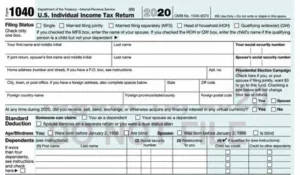
Last time, I mentioned the IRS Form 1040, where all the totals of the tax return end up. I also said that understanding this form is going to help us save.
Today I will use the version that is expected for next year.
The first section contains the information that identifies who is declaring (or if they are a married couple). This section includes social security numbers, mailing address, dependents, their legal status for tax purposes, the list of those who can claim dependents (something that will be discussed in future blogs) and other details as you see in the image.
However, the second part gets interesting because it is where you can start saving. Why? Simply because it us where you declare your income. However, the question is:
Does all the money I receive in a year have to be declared in income?
The answer is no.
It is important the before filing your taxes, you identify the source of all the money you received in that year, because the money EARNED in the United States is the one that is added as income in you taxes.
Money earned working in another country (in which you had to pay taxes) is not counted in your income (although for informational purposes, it is reported depending on the amount).
In the same way, money that you have borrowed, or money that you receive as government aid does not count either. In short, if you did not earn it, you do not declare it and therefore you do not pay taxes… on that amount.
Now, what types of income do I declare? And more importantly, what are the deductions that I can use to pay less taxes? All this goes in the second half of the 1040, which we will be discussing next time.
 English
 Español
